QUEPO 25 - 2011 Contents:
- 1.1 Gardens. Madeira's Botanic Garden. Pamela Puppo.
The author visited this garden and comments about the succulent plants she found in it.
- 1.2 Succulents from Yemen and Socotra. Mildred Canales.
The author traveled to this remote country in Arabia and to the island of Socotra and sent us some pictures of the remarkable and unique succulents from these places.
- 1.3 Categorizing the Cactaceae (IUCN). Jose Roque.
Early in May this year took place a workshop about categorizing of cactaceae from Ecuador, Peru and Chile in Santiago. One of the Peruvian participants comments about this important meeting.
- 1.4 Cactus and Climatic Change. Carlos Ostolaza.
The author explains why he thought the cactaceae will tolerate the climatic change better than other plant families.
- 1.5 The planet is sick. Debora Mac Donald.
An important meeting about the importance of recycling took place in Lima with Al Gore as the main lecturer and the author tell us her impressions about the conclusions.
- 2.1 Art. Andrés Zevallos. «Craso».
This Peruvian artist has depicted a typical andean town street fenced in with some cactus.
- 2.2 Art. Julio Camino Sbnchez. «Craso».
A couple of engravings showing some agavaceae from this peruvian artist are presented here.
- 2.3 Literature. Bethoven Medina. Orlando Granda.
This Peruvian poet offers us a short poem called ((El tunal)) that Orlando Granda sent us for this issue.
- 2.4 Literature. Iris Zollner. Debora Mac Donald.
Another Peruvian poet sent us, through Debora Mac Donald, a poem that we share with the readers.
- 2.5 Philately. Stamps with cacti. «Cactofilico».
A stamp from Chile and another one from Bolivia showing some cacti but not as the main subject issue, are commented here.
- 2.6 Report. Xlll Conabot 2010. Carlos Ostolaza.
The thirteenth Peruvian Botanical Congress took place in Tingo Maria, in Huanuco Dpmt. This is a report of that important meeting.
- 3.1 Succulents. New Crassulaceae from Peru. Guillermo Pino.
Four new Crassulaceae described in Peru in the last years are presented. They are Echeveria andicola, Sedum renzopalmae, Sedum isidorum and Villadia klopfensteinii.
- 3.2 Succulents from Tenerife, Canary Islands. Pamela Puppo et al.
This island from the Canary is rich in succulent plants and as all islands the plants growing in it are unique.
- 3.3 Succulents. Euphorbia pteroneura. Miguel Chazaro.
This mexican Euphorbia species from Chiapas and Veracruz is commented by the author with several pictures of the plant.
- 3.4 Cactus. Neowerdermmania peruviana. Daniel Montesinos.
The botanical characteristics, ecological distribution, popular uses, and the association with other plants of Neowerdermannia chilensis subsp. peruviana (Ritter) Ostolaza called 'Towana' from the highlands of Moquegua, (3530-4120 m) are presented.
- 3.5 Cactus. After Dr. Rose's footsteps. Carlos Ostolaza.
This is a report about Dr. Joseph Rose wanderings in Peru in 1914 looking for cacti and the species he found and described with Dr. Nathaniel Britton in theirfamous monography The Cactaceae in two volumes.
- 4.1 Confidential. «Specstador».
Specs main activities during the second semester of the last year and the first semester of this year are described.
- 4.2 Abstracts. English summary of all the articles of this Qiepo issue.
- 4.3 Books. '101 Cactus del Peru'
This is a review of all the cactus genera and half of the species from Peru in a large format book with more than 250 pages.
'Cactus del extremo norte de Chile'. This beautiful book reports 19 cactus species from Arica and Tarapaca in northern Chile.
|
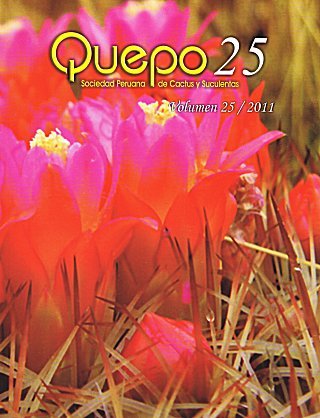
Cover Picture : Oroya peruviana Britton & Rose
Plus Editorial 1;
Specs Information 2;
Specs´ New Members 4;
Quepostal 15,
Benefactor Members Information 44;
Quepo´s Subscription Form |
|---|

